
Santiago Tabernero, in sips. The alchemist of emotions.
By Lali Ortega Cerón
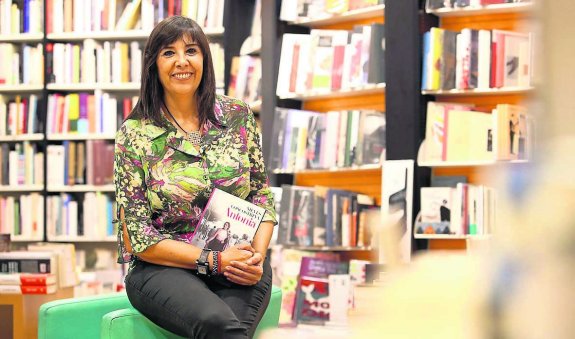
Where a glance perceives bare vines, and hears how the north wind climbs and dodges the Sierra de Cantabria, the Riojan journalist, film director and scriptwriter Santiago Tabernero imagines the most disparate sequences, the most unsuspected dialogues, the most recurrent scenes. Among the leaves of fire and gold lying on the ground, his imagination composes, in a matter of seconds, a sequence of love in capital letters or the most enigmatic crime. The bare vines of winter are an inspiration.
To interview Santiago Tabernero is to discover that life sometimes puts talent in its place. That certain people possess a sensitivity and a more intense, more special perspective on life. Different and sensitive. He is a great conversationalist, a magician of language. He is the alchemist of emotions.
On 26 December, this scriptwriter, journalist by trade, creator in 1998 of the film programme Versión Española (TVE), the only programme in Spain dedicated to cinema for the last 18 years, will put the little ones (and their companions) in his "magic pocket". Between drinks, it will be time to chat with Santiago Tabernero about the lights and shadows of cinema, wine and life. Even about the smell of those cinemas where magic caught him when his sister took him, with her friends, to see a film by Los Bravos. Ever since he experienced that incredible liturgy of entering a large cinema, turning off the lights and starting to project a colourful story onto a wall... he decided, and he has fulfilled it, that he too would have the soul of a cinema.
Years ago going to the cinema was something incredible for a child, like going to the moon. The smell of those big halls was different from anywhere else, different from the smell of life.
Is the gaze of a screenwriter and a film director like that of ordinary mortals?
No! (Laughs) It is precisely in the DNA of a screenwriter that there has to be a very particular panoramic view of life and people, which consists of trying to find the reasons for each character, the motivations. By nature you have to be a very understanding person, very tolerant, a humanist whose profession requires him to look through characters with different motives. Yes, I think you have to have a particular look.
In casting there will be a lot of smell, a sixth sense to discover talent, a crush like the ones that happen in real life, and that doesn't have to be only love...
Absolutely. A large part of a character is given by the physicality, the gestural expression that he or she brings to the character. In that sense, on many occasions, in these castings, the director finds what he is looking for among so many faces. In my case it happened in Vida y Color. We were looking for the actor for the character of Javi, the neighbourhood hero. We auditioned a lot of young actors and we couldn't find him. I remember we were at the production company, the doorbell rang, and by chance I opened the door. It was Miguel Ángel Silvestre -good morning, I've come to audition-. As soon as I looked at him I knew it was him, and then at the casting he confirmed it. It was his first film character.
When you get stuck on a script...
Ufffff (Laughs). The best thing to do is two things. One is to take it to purgatory, put it in a drawer and see, as with wine, how the story and the characters evolve so that, some time later, they give you a new perspective. Another possibility is to realise that you've taken the wrong path... and throw it in the bin. That one goes straight to hell!
Which person has left you with a very pleasant aftertaste over time?
Maybe it's a cliché, but in any case it's sincere. To continue talking about screenwriting, it would be Rafael Azcona. I had the immense fortune of meeting him. A native of Logroño, a genius, an example of a scriptwriter who, from his humanity, was capable of putting himself in the shoes of any character. He was also an extraordinary person, a talkative, friendly, tremendously approachable, sentimental man... People like him are one in a million.
And in life outside the cinema...
Of course, family and parents are people who mark your existence. At school, at school, teachers who are teachers (like my teacher Muguruza at my Jesuit school, who is still a reference point today). And then we enter the realm of love. With Paz, my girl, we've been in love for 30 years... and we're still in love, which is an understatement! And referential friends. Looking at the balance sheet, it's devastating because many of them, for various reasons, have died. It is terrible. I miss them very much. Cillero, Daniel González... Suddenly you realise that there are open windows in your building, the wind is blowing, and it's cold.
I get the feeling that you are one of those people who listens to
Maybe it has to do with the scriptwriter's streak. Listening is your permanent source of information. You can't switch off. I don't know if a scriptwriter is born or made; if I like listening so much because I'm a scriptwriter, or vice versa. But fiction is nourished by life and life is full of fictions. Listening to people is a wonderful pastime. I find it easy. Sometimes I realise that in some people there is a "listening" deficit and they only hear themselves, accompanied by a verbosity of which they are unconscious and which probably prevents them from growing.
Your first contact with wine
Yes, of course. Look, it's something very traditional in poor Spain and specifically in La Rioja. When there wasn't any, children were given bread with wine and sugar as a snack. I remember some afternoons in the Barrio de San Lázaro, where I lived, which is partly the germ of my first film Vida y Color. I remember being seven years old in the muddy, puddled street, crestfallen, meditative, thinking about what to do with myself and how to be one of the gang (because I wasn't) and probably eating that bread spread with wine and sugar. (He laughs).
In the audiovisual scriptwriting course they told us that, in a film, the evolution of the characters was vital. What has Santiago Tabernero's journey been like until he reached December 2015?
Well... (Smiles). It's true. In every script you need the cotton wool test. That is to say, that in the temporal arc in which the story evolves, the characters arrive at a place and it changes them, it has made them grow as people, or it has expelled them from somewhere. Life is a long script that passes very quickly. Now, at 54, I say that I am at the beginning of the third act of the script of my life. One does not stop changing throughout one's existence and, nevertheless, one does not stop being the person one was. I was 90% of who I am when I was a child. The look, the restlessness, the sensitivity, a certain empathic capacity, all of that was probably already in me when I came out of my shell. And I am immensely fortunate that this nature that was given to me has only been re-founded or recreated with the incorporation of knowledge, people and experiences. I sometimes say that this reincarnation is going well. (He laughs). Cinema and wine have a lot in common. But perhaps one of the most salient issues is that they have to be made throughout the whole process with passion. Whether it's the film director or the winemaker, in both cases the personal commitment is very sincere.
In which film has Santiago Tabernero emptied himself?
Wow! I ask for the joker of the call. (laughs). I put my heart into everything I do and everything I sign represents me. Specifically, in cinema, in the two films I have directed. Vida y Color and, a year and a half ago, Presentimientos. In both of them I went against my limits. If there's one thing I find encouraging about filmmaking, it's that it's an immeasurable challenge. It forces you to be so sharp, so awake and absorbing of information, to process it quickly and find answers you didn't know you had. Filmmaking is like climbing an 8,000m. I have to prepare myself, the path is frustrating, sometimes you have the feeling that you are an impostor and at the same time you feel that the earth is moving under your feet, that it is spinning, and that you are smarter (or dumber) than you thought you were.
Which is easier, to make people laugh or to make them cry?
Undoubtedly, to make people cry. Laughter is an emotional and intellectual exercise, the product of a paradox, a contradiction, an absurdity... Humour is a very difficult specialisation, although some people are particularly gifted. Making people cry, provoking fear or unease is easier. In this case, reflex tics are simpler.
Should we go to the cinema in tears, or should we seize the moment and take it out on ourselves?
No, no, we have to be ready for the film to shake us up, to move our laughter muscles and bring out the onion of tears, to shake the expectation of the child! You have to be ready for things to happen to you. And even if you feel vertigo, you are inside a permit, which is fiction.
The film you still have to make
I have ideas for three or four. People in La Rioja always ask me what's your "Captain"? I want to make a medieval film, in La Rioja, inspired by Captain Thunder. Only that I take my heroes at the end of their lives, when illness, death and the sense of everlastingness lurk. Characters who have lived their adventures in a free and wild world and who, when they wanted to ask for early retirement, the greatest adventure of their lives awaits them, against their limits. One of my plans is to take the script out of the drawer and make it a reality.
Well, it will come out...
I really like a song by Marlango that says "what you dream, flies". And in my life, what I've dreamt of with enough strength has ended up flying. Fulfilling itself.
Silvia Abascal, Eduardo Noriega, Miguel Ángel Silvestre, Carmen Machi... just as wine is an art, it is no less artistic to be able to bring out an actor's best performance.
Well, yes, yes. Actors are very particular people. They are ventriloquist's dummies that need precise instructions, both in relation to the character, as well as empathetic solutions, to be able to feel confident. They are very fragile musical instruments that, as soon as you are careless, a string goes out of tune. I have had the immense good fortune to work with very talented actors who have trusted me and I have trusted them. We have had precious moments of communication together on the set. If you start from a previous friendship, as with Eduardo Noriega, it becomes another degree of friendship and camaraderie. Actors are tremendously shy in their personal lives. When the spotlight is on them and the voice Action! comes up, at that moment they are actors playing their role. But they are very vulnerable people: a bad critique or a director's opinion, not sufficiently heated, makes them retract, makes them more awkward in the next take. It's a delicate balance between the director as a medium with the person, with the actor, so that from this dialogue a new magic emerges in a character that didn't exist.
Another of the similarities between wine and cinema is that, almost bordering on the intimate, both depend on the treatment of light, shadows, time and silence. Vida y colour, your opera prima, nominated for the 2006 Goya Award for Best New Director and Best Ibero-American Film at the 2006 Miami International Film Festival, has the chiaroscuros of life itself.
Has there been a film that has given you light in a dark personal moment?
Yes. In a moment of existential depression (smiles), Tim Barton's film Ed Wood ingratiated me with life and with the hope of living. And, for other reasons, Steven Spielberg's Minority Report.
And conversely, have you received feedback from any viewers whose path you have illuminated?
Yes, yes, yes. With Vida y Color I have had very exciting experiences with the spectators in the sense that you say. That it has moved them, that it has made them remember the child they were, that they had that album and it has reminded them of their grandfather... I remember in Toulouse, which happens to be the capital of the Spanish Republic during Franco's regime, where many Republicans went into exile. We did a screening at the Festival. At the end, an old man came up to me - I get excited just thinking about it - in his eighties. Spanish. Exiled. And behind his infinite wrinkles there still shone the eyes of a child, probably frightened, and excited, and when he thanked me he burst into tears. He burst into tears... -I can't go on-.
Presentimientos, based on the novel by Clara Sánchez, could be an example. What recipe would you give to avoid falling out of love?
It's a film about relationships, about love, which needs to be worked on so that routine doesn't take over. So that there doesn't come a time when love has vanished, has gone out the window. A couple who have a baby... Because if a child is not wanted, it can become a black hole through which love disappears and goes into a tailspin. I believe in second chances. In a couple's crisis, if the feelings remain, or if it produces a catharsis that makes them think about why the other is important in their lives, it is worth it. Life is built on second chances. Otherwise it would be absolutely terrible to live.
The most eloquent silence in cinema?
There is a film with very little dialogue: 2001, A Space Odyssey. Full of silences that force you, probably, to elaborate the script as a spectator. The silence accompanied by the soundtrack, the Strauss waltz, helps you to construct the dialogues yourself. There are so many films. I've seen so many that it's very difficult for me. Melancholia comes to mind.
That film that still moves you
I've been moved so many times! I'm a big crier, I cry a lot at the cinema. In a romantic comedy, when happy solutions arise, when they kiss, when the actor has that dialogue of redemption, when a person has overcome challenges, is nobler and faces life with a new determination... that moves me. Holy Motors, The Lovers on the New Bridge, A True Story, Earth made an impression on me when I saw it...
The worst nightmare
Making a good film is so difficult, such a complex alchemy even for good directors! Even the best ones have an uneven track record. It's normal that the mayonnaise gets cut somewhere. (laughs). Some of them insult my intelligence and my sensibility. And in that case, when it doesn't represent me, it becomes a nightmare that I don't give much of a chance. In general, I don't like commercial, popcorn films. And even if they talk about feelings, I get the feeling that I'm being ripped off.
A bit of nostalgia. Your image as a child in those great cinemas of the city, the Sahor, the Avenida, the Bretón... that strike us into the past.
They make me feel carpetovetonic, tremendously old. It belongs to a world to which we will never return: that of the great popular cinemas of the provinces. Logroño was a very small city, where you immediately found yourself on the margins of the dreamable. In that provincial town, going to the cinema was something incredible for a child. It was like going to the moon, to a party. Even the cinema smelled different from anywhere else, from the way life smelled. There was even an advertisement 'room scented with Menforsan'. The chairs didn't look like the Formica chairs at home. And that screen, a gigantic sheet where everything was possible! Going through the box office, the ritual of the usher, we miss it very much. Now we have big plasma screens at home, the quality of the image is total, the technological advances. But at any moment the phone rings, you hear the neighbour's cistern, anything interrupts the story you are being told in images. Before, in the cinema, time was suspended. Not now. You go to the fridge, you take an olive, and the story fragments. In a way you are in charge of the film. Before, it was in charge of you, it was wonderful.
Which actor has made the biggest impact on you in shortfilms?
The first one that comes to mind is Javi Cámara. I'm also lucky enough to be a good friend of his. An illustrious Riojan, he is an exciting person. He is exciting as an actor and I believe that what the spectator senses on a cinema screen is corroborated in his life. He has an empathetic capacity, a sensitivity, a culture, a contagious sense of humour...
You talk a lot about music...
I love music! I've sometimes said that I like music more than cinema. It's an abstract art. Cinema, except for specific experiences, has to be realistic, like Goya or Velázquez. It has to resemble life and recognise itself, it has to submit to a series of unwritten rules. However, music moves in the sensorial terrain, in the realm of emotions. I enjoy it very much. Unfortunately I don't know music, but there is nothing that makes me more envious than to see an elderly composer slide his fingers across the keys and produce a marvel. I used to buy dozens of records, I couldn't fit them in my house, then Spotify came along and my life changed! Music in film is something extraordinary and an ally. In my two films I've worked with great musicians.
And that actress who embroiders any interpretation
With whom I have had a direct relationship... probably Silvia Abascal in Vida y Color. You know that her sister, Natalia Abascal, the girl with Down's Syndrome who plays Ramona, also took part. Silvia moved me not only as an actress, but also as a sister, as a coach, as a person of extreme sensitivity, very fine, exquisite... Plus the overcoming of the tremendous crisis that occurred at the Malaga Festival, which has led her to a long ordeal from which she is gradually emerging, make me think of Silvia Abascal as a modern heroine. And Carmen Machi, with whom I have a very nice relationship. Everything I've told you about Javi Cámara would be the same for her.
Next Saturday 26 December, you will have a meeting with the little ones thanks to the programme Vivanco Kids. And, in the afternoon, a relaxed chat, drinks and tapas included, with a more adult audience.
What are you going to surprise us with?
You can see I'm easy to talk to! I hope that the children's curiosity, the curiosity they may have for me, and the curiosity I discover in them, will lead us to laugh, to talk about a thousand things, about what amuses them, about their characters, their heroes. It's going to be a great time!
What does a scriptwriter and director learn from children on a film shoot?
Children are the repositories of humanity. They are in themselves all human beings and they don't have to apologise for it. They have not yet caught up with civilisation. Their every act is natural and they probably have the same reactions as a child of the Stone Age. In that sense, because they are good savages, all children of any age look alike, they are the same child. For a scriptwriter, for someone who likes to watch and listen, a child is an inexhaustible well of fascination.
Now at Christmas, what a lot of "scenes" you could find around a table!
Take a look! Christmas is associated with family. 60% of films in the history of cinema talk about it. The couple, the minimum redoubt of civilisation, is the result of a choice. A family is the breeding ground from which one starts. Families are comic in themselves, because they are dramatic, tragedy passes easily through their destinies, the family associated with Christmas, the "I'm fed up with it, I want it to end as soon as possible! would lead us directly to some kind of black comedy, costumbrista, which in the hands of Rafael Azcona, as it has been, or Berlanga, would provoke masterpieces such as Plácido.
What would cinema have been without wine!
Wine as the driving force of cinema appears in many films, as a theme, a background, an instrument that unites or separates... It is also part of cinematographic creation. I usually write with a glass of wine and it helps me to think, to debate, to colloquy, to reflect. The last script I'm writing... this afternoon I'm meeting with the co-writer to finish it, my great friend Borja Echeverría, and open a bottle of wine, pour us a glass of Rioja and talk, tangle, and think about the future of the characters, it's all one! Wine, I am sure, is in the back room of many creative processes.
Well, that's as far as we've got. Do you want to add anything else?
(Lots of laughter) I'm empty!
If you want to come to the #ManerasDeContar la Cultura del Vino talk on 26 December, you can buy your tickets here: http://vivancoculturadevino.es/es/reservas/
Here you can see how we enjoyed ourselves with Pepe Viyuela