Personal, pioneering and exclusive
VINTAGE
2021
production
20.880 botellas numeradas.
HARVEST
The different grape varieties were harvested by hand in small containers, separately and at their optimum moment, according to grape tasting and analysis, between the first and second week of September.
WINEMAKING
All the grapes go through cold storage and a selection table. The extraction of the must is gentle and delicate, with a low yield in order to obtain pure, fruity musts that respect the terroir as much as possible. The musts obtained from each variety undergo an initial alcoholic fermentation separately in small stainless steel tanks at a controlled low temperature. Once fermentation is complete and after a period of time on the lees, they are racked and the selected blend, or cuvée, is made from the single-varietal white base wines in the proportions indicated above. This blanc de blancs is left to settle until January, when the second fermentation in the bottle, characteristic of the traditional or champenoise method, takes place.
LONG MATURATION IN BOTTLE
The bottles are kept in the natural coolness of the cellar's underground cellars for 30 months, in contact with their lees, where they acquire harmony, complexity and depth in aromas, textures and fine effervescence. Subsequently, in August 2020, it is disgorged with the sparkling wine's own filling to preserve even more of its personality, and with a tiny dosage of 0.6 g/l, Extra Brut, which only harmonises the lively acidity without masking the purity of the varietal and the terroir. It remains corked in the bottle for at least another 10 months to perfect its elegant maturity before being released on the market.
TASTING NOTES
Pale yellow colour, lively and intense, which begins to show its long maturation in the bottle. Fine, persistent bubbles. Fresh and complex aromas of stone fruits, white flowers, citrus and tertiary notes of dried fruits and brioche bread very well assembled. On the palate the effervescence is present, but caressing with a creamy texture that shows, once again, that balance between the vibrant acidity of youth and the elegant envelope of maturity. The finish is deep and delicate, with a mineral and saline background that invites you to continue enjoying.
THE CONCEPT
In 2015, the Control Board of the D.O.Ca. Rioja began, for the first time in its history, the process of assessing a possible new category of quality sparkling wine within the appellation. To this end, its technical committee commissioned a team, led by Rafael Vivanco, fourth generation of the family and winemaker at Bodegas Vivanco, to develop and propose its regulations, studying Rioja's potential and the most successful international cases.
Finally, in 2017, the proposal based initially on Champagne (manual harvest, traditional or champenoise method...) but with the personality of the Rioja terroir and grape varieties was approved with great consensus, reinforced in quality even more with lower yields, lower sugar content (only Brut Nature, Extra Brut and Brut), longer maturation on the lees between tirage and disgorgement (minimum months: Generic 15, Reserva 24 and Gran Añada 36), as well as having to pass the finished sparkling wine a demanding tasting by a panel of experts before it can be released on the market.

PAIRING
A very gastronomic and versatile wine that can be enjoyed from start to finish with seafood (oysters, scallops, prawns...), sushi, sashimi, foie gras, Iberian ham, caesar salad, salmon in puff pastry, paella, pasta, roast lamb, pigeon, baked turbot or monkfish, goat's curl, Comté cheese, dark chocolate with olive oil and fleur de sel...
PERSONAL, PIONEERING AND EXCLUSIVE PROJECT
The first harvest in which the production of quality sparkling wine was officially authorised in the D.O.Ca. Rioja was in 2017. Very few wineries applied for permission to start the first vinification, being Bodegas Vivanco one of them, after two harvests and experimental sparkling wine elaborations, due to Rafael Vivanco's personal determination, in order to explore and know the aromatic and ageing potential of each of the Rioja varieties.
For all these reasons, Bodegas Vivanco is a pioneer in the production of a highly unique sparkling wine, using mainly native Riojan varieties in its selected blend or cuvée (hence the brand name “Cuvée Inédita”) with a minimum dosage and high ageing potential, aimed directly and exclusively at the Reserva category.
THE VINEYARD, LA CONCEPCIÓN ESTATE
Own vineyard of 42 hectares located on a gentle slope at an altitude of over 500 metres in Briones, Rioja Alta. Flanked to the north by the Sierra de Cantabria and to the south by the Sierra de la Demanda, it owes its name to the nearby 16th century Ermita de La Concepción. It is a unique and pioneering vineyard in Rioja as it exclusively grows a collection of all the different white grape varieties authorised by the denomination. It enjoys the best conditions for the cultivation of these grapes: a clear Atlantic climatic influence, as well as its fresh, deep, clayey-calcareous soils, which give the grapes a slow and balanced ripening in sugars, lively acidity, varietal aromas and fine minerality.
NEW GRAPE VARIETIES
This is the first time that a sparkling wine has been made with these mainly native Riojan white varieties: 45% Maturana blanca, 30% Tempranillo blanco, 15% Viura and 10% Chardonnay.
Recently recovered from extinction, the white Maturana is the oldest Rioja variety known in written records, as it is mentioned as early as 1622. Like Godello and Verdejo, it comes from a cross between the Traminer (or Savagnin) and white Castellana varieties. Although it is still a minority variety (only 39 ha in Rioja in 2020), Bodegas Vivanco is a pioneer in its cultivation and production of different white wines. The wines from Maturana blanca have an intense golden-greenish colour, aromas of white stone fruit, citrus and herbaceous notes, good structure and depth in the mouth, low pH and great ageing potential for the production of sparkling wines.
THE LABEL
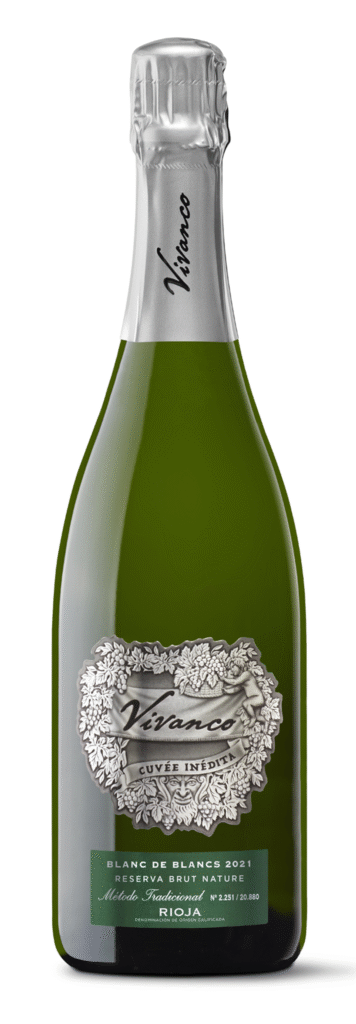
Inspired by the oldest silver labels, 18th century, on display in the collection of our Vivanco Museum of Wine Culture, Briones, La Rioja. These early and exclusive labels were hung on the decanters to indicate the origin of the wine that travelled in barrels from its place of production.